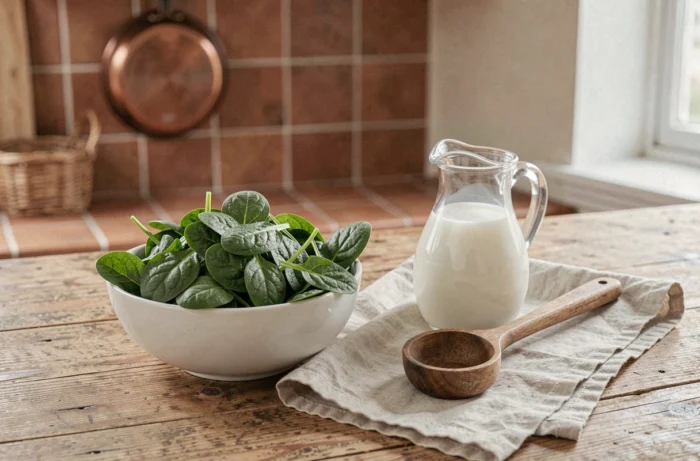
When sautéing spinach, the question of accompanying liquid quickly arises. Should you pour a splash of milk, add a spoonful of cream, or both? The answer depends less on culinary dogma than on what you expect from the dish: texture, flavor, nutritional value. Spinach and dairy products form an ancient duo, but the choice between milk or cream for spinach really alters the result on the plate.
Oxalates and calcium: what happens before the cream or milk
Have you ever noticed a slight gritty feeling in your mouth after eating plain spinach? Those are oxalates, natural compounds found in large quantities in this vegetable. They bind to calcium in the intestine and reduce its absorption.
Adding a dairy product is not enough to solve the problem. Pre-cooking in water, followed by draining the liquid, reduces soluble oxalates more than steaming or directly sautéing. This step is more important than the choice between milk and cream.
On the other hand, consuming a calcium-rich food during the same meal can bind some of the remaining oxalates in the digestive tract. Milk, used in a more generous quantity than cream, can provide an interesting calcium supplement. For those prone to oxalate kidney stones, this combination should be discussed with a doctor. The question of milk or cream for spinach takes on a dimension that goes beyond just the recipe.

Spinach with cream: texture and carotenoid absorption
Fresh cream (whether thick or liquid) contains significantly more fat than whole milk. In cooking, this changes two concrete things.
First, the texture. Cream coats the spinach leaves, creates a creamy binding, and gives the dish a satin appearance. Milk, being more fluid, produces a lighter result, sometimes almost liquid if the quantity is not controlled. If you’re aiming for a side dish that holds on the plate, cream provides a coating that milk cannot replicate.
Next, the nutrients. Spinach is rich in beta-carotene and lutein, fat-soluble carotenoids. Their absorption by the body increases in the presence of fat. Therefore, cream promotes this assimilation better than semi-skimmed milk.
Thick cream or liquid cream for spinach
Thick cream (fermented) adds a slight acidity that enhances the spinach without needing to add lemon. It is incorporated at the end of cooking to avoid curdling.
Liquid cream handles heat better and integrates during cooking. It produces a more homogeneous sauce. For a spinach gratin or quiche, liquid cream mixes easily with eggs and flour.
Spinach with milk: lightness and specific uses
Milk does not seek to compete with cream in terms of creaminess. Its role is different. It adds sweetness, softens the vegetable bitterness of spinach, and lightens the preparation.
A dish of spinach with milk is better suited when the vegetable is not the main element. For example, in a béchamel intended for lasagna or stuffed cannelloni, milk serves as a fluid base. Using cream instead would weigh down the whole dish, especially if other rich ingredients (parmesan, butter, salmon) are already present.
Here are some guidelines for choosing milk:
- Whole milk for a sweet and slightly creamy result, suitable for spinach purées intended for children
- Semi-skimmed milk when you simply want to loosen the preparation without adding notable fat
- Plant-based milk (soy, oat) for a lactose-free version, knowing that calcium content varies by brand and fortification
Cooking spinach: mistakes that ruin the dish
The milk-cream debate becomes secondary if the cooking itself is mishandled. Spinach releases a lot of water, and this water dilutes everything added afterward.
Draining the spinach after a first pass in boiling water is essential. They are pressed in a colander or between two plates to extract as much liquid as possible. This step also reduces some of the oxalates.
After draining, you can quickly sauté them in butter or olive oil before incorporating the milk or cream. The order matters: adding cream to waterlogged spinach produces a sauce that does not bind.
- Blanch fresh spinach in a large volume of salted water for two to three minutes
- Immediately plunge them into ice water to set the green color
- Drain and press them before any further cooking
- Incorporate the dairy product at the end of preparation, over low heat, to avoid curdling the cream or coagulating the milk

Comparison table: milk or cream for spinach
| Criterion | Milk | Cream |
|---|---|---|
| Dish texture | Light, fluid | Creamy, coating |
| Fat content | Low to moderate | High |
| Carotenoid absorption | Moderate | Enhanced by fat |
| Calcium content | Higher (larger volume used) | Lower (small amount) |
| Suitable recipes | Béchamel, purée, lasagna | Side dish, gratin, quiche |
The choice between milk and cream depends on the dish, not a universal rule. A spinach quiche naturally calls for cream, mixed with eggs and sometimes parmesan. A spinach purée meant to accompany a pan-seared salmon can suffice with whole milk and a knob of butter.
If the dish already contains rich fat ingredients, milk is enough. If the spinach is served alone or with a lean food, cream gives it body. Blanching and properly draining before adding anything remains the only step on which there is no debate.