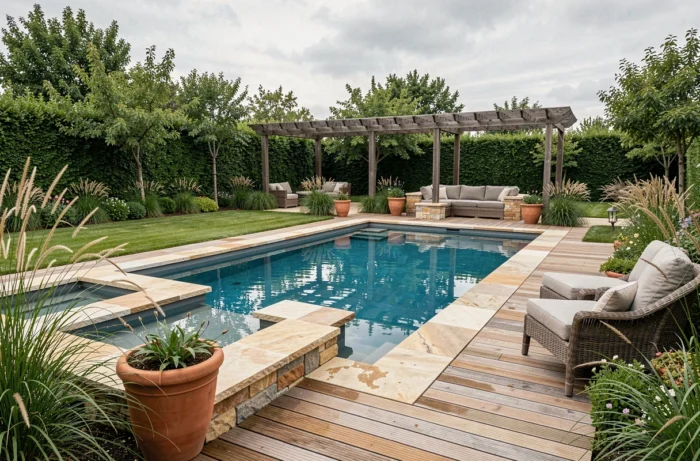
The modern outdoor pool layout is no longer just about laying four slabs around a basin. Regulatory constraints (prior declaration beyond 10 m², local PLU, drought orders) and the trend towards energy efficiency are reshaping technical choices. We have selected ten concrete layouts that meet these requirements while creating a well-designed outdoor space.
1. Integrated swimming lane with flush coping
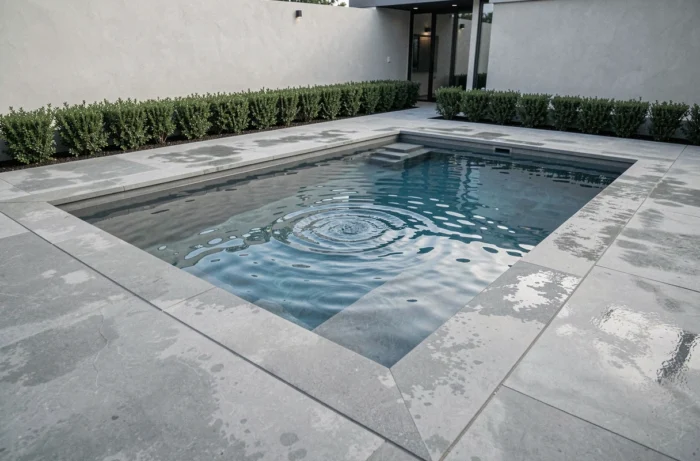
The swimming lane, with its reduced width and optimized length, consumes less water than a traditional pool. We recommend a flush coping (level with the finished ground) that eliminates any visual break between the deck and the water surface.
This choice requires a peripheral overflow channel connected to a buffer tank. The sizing of the tank must absorb the wave volume generated by swimming. The flush coping requires millimeter-level leveling to avoid unwanted overflow towards the plant beds.
Regarding regulations, a swimming lane often exceeds 10 m²: a prior declaration remains mandatory, in accordance with articles R.421-9 of the Urban Planning Code.
2. Immersed beach with non-slip exposed aggregate concrete
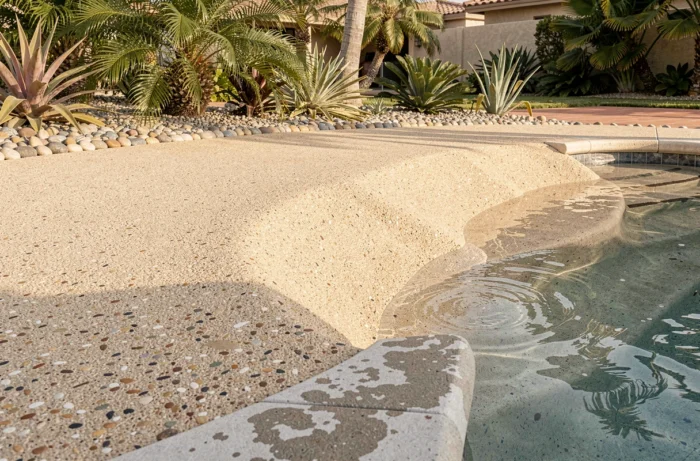
The immersed beach extends the pool by a few centimeters in depth. Exposed aggregate concrete, with its protruding aggregates ensuring a high slip resistance coefficient, remains the reference material for this wading area.
Several landscapers exploring modern outdoor pool layout ideas favor this configuration because it creates a smooth transition between the dry terrace and the swimming area. Maintenance is limited to an annual high-pressure cleaning to remove algae from the aggregate’s crevices.
3. Composite wood deck on aluminum joists
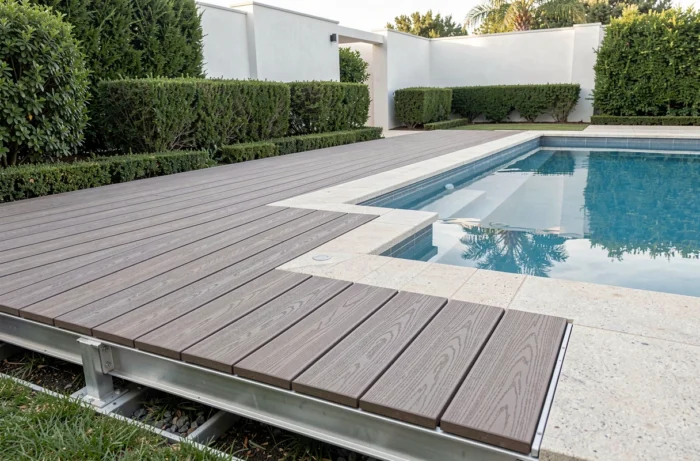
Composite wood has replaced exotic wood on most pool projects. Its dimensional stability makes it insensitive to chlorinated splashes, and it requires neither saturator nor seasonal sanding.
The aluminum joists eliminate the risk of rot in the support, a recurring weak point of treated pine structures. The recommended spacing varies according to the board section, but installation on adjustable pedestals facilitates the management of drainage slopes towards the drains.
4. Bioclimatic pergola against the pool deck
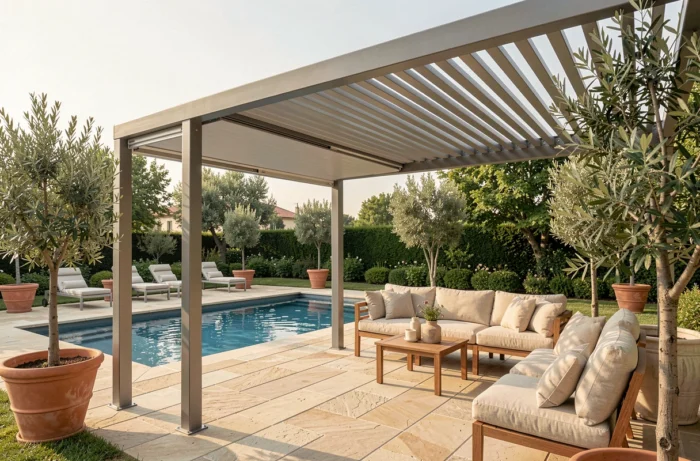
A motorized bioclimatic pergola with adjustable slats creates a modifiable shaded area without blocking natural ventilation. Positioned away from the pool, it protects the garden furniture from UV rays while allowing air circulation, which limits condensation under the structure.
We observe that self-supporting models with integrated gutters are better suited to pool surroundings than versions attached to the facade, as they avoid drilling into the load-bearing wall on the garden side. The aluminum structure withstands volatile chlorine better than painted steel.
5. Landscape rockwork and filtering plants around the perimeter
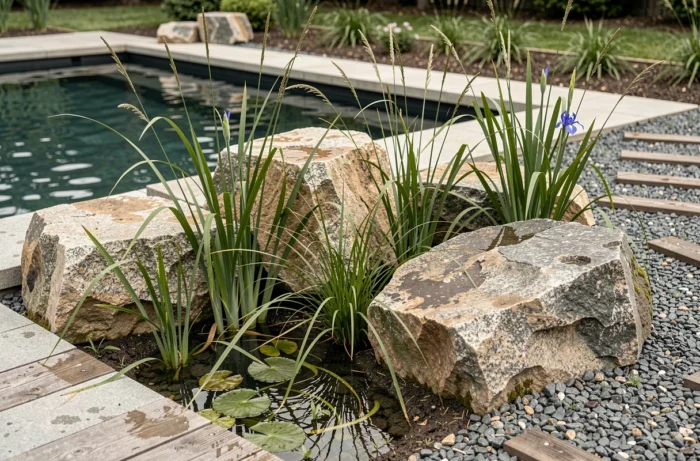
Natural rockwork, arranged in tiers, stabilizes sloped terrain while creating a mineral decor consistent with a contemporary basin. Local stones (limestone, schist, sandstone depending on the region) integrate better than imported rockwork.
On the plant side, ornamental grasses (miscanthus, pennisetum) and phormiums tolerate chlorinated water splashes. Absolutely avoid deciduous or fruit-bearing species (olive, cherry) that clog the skimmer and increase filtration load.
6. Submersible LED lighting with color temperature variation
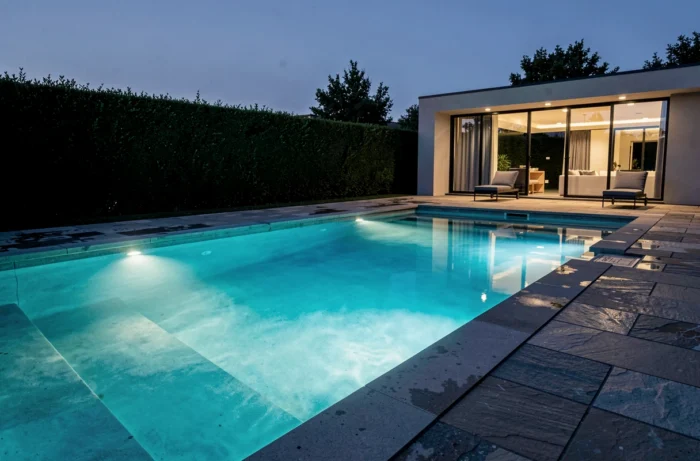
Submersible LED spotlights filled with resin allow for sealing without niches, suitable for both polyester shells and concrete basins. The color temperature variation (warm white to cool white) offers two distinct atmospheres depending on use: relaxation or reception.
A 12 V low-voltage transformer is mandatory in volume 0 and volume 1 around the basin. The power supply connects to the pool’s electrical box, separate from the main panel of the house.
7. Compact pool house with integrated technical room
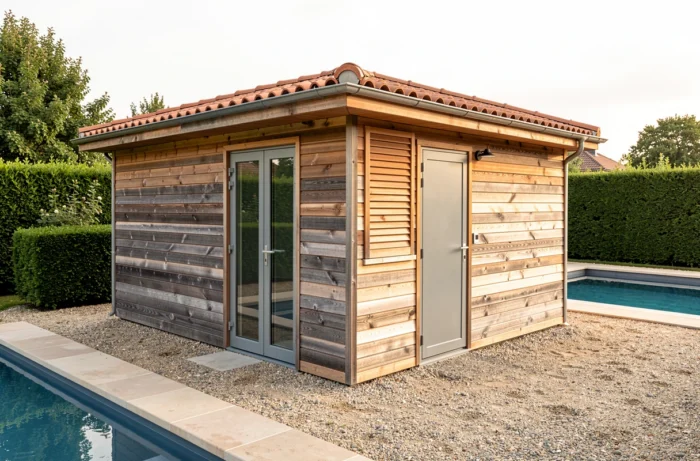
Consolidating the technical room (pump, filter, pH regulator, electrolyzer) within a dressed pool house avoids unsightly ancillary constructions. A volume of a few square meters is sufficient if low and high ventilation is properly sized.
The pool house can also house an outdoor shower and storage for pool accessories. Urban planning formalities depend on the footprint and provisions of the local PLU: a check at the town hall is essential before starting the project.
8. Low-consumption filtration system and automation
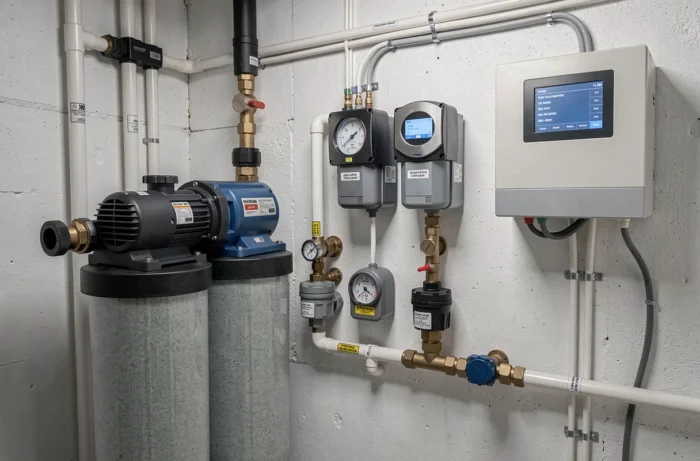
The trend towards water and energy efficiency drives manufacturers towards variable speed pumps and recyclable filter media (glass, zeolite). These devices significantly reduce electrical consumption compared to traditional single-speed pumps.
Automation (ORP probe, pH regulation, scheduled programming via app) limits manual interventions and optimizes filtration cycles. In the context of drought restrictions, a well-automated basin consumes less replacement water, which can make the difference between allowed use and a prefectural ban.
9. Sliding mobile safety terrace
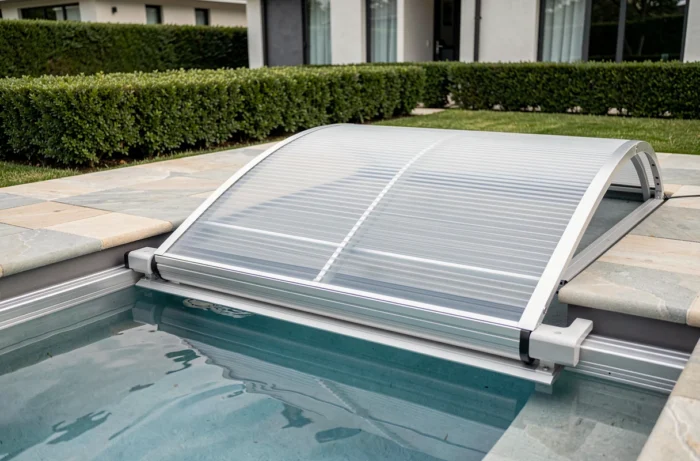
The mobile terrace is a motorized platform that completely covers the basin. It simultaneously serves three functions: safety cover, thermal insulation of the water surface, and increased usable area when the pool is not in use.
This device is particularly suitable for modest-sized gardens. The guiding rail must be integrated during the main construction of the basin, as adding it during renovation requires costly masonry work.
10. Natural stone coping laid on a draining mortar bed
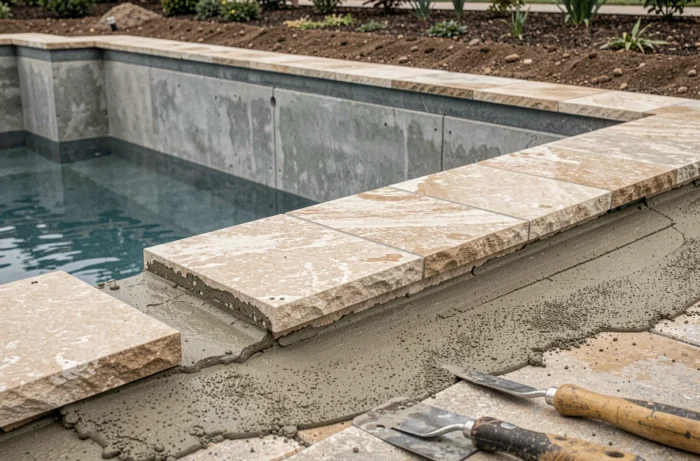
Natural stone (travertine, quartzite, flamed granite) remains the most durable coping material. Installation on draining mortar prevents capillary rise that cracks the joints during freeze-thaw periods.
The choice of surface finish affects safety: raw travertine offers natural grip, while granite requires a flamed or bush-hammered treatment to achieve an acceptable non-slip level.
Each layout listed here meets a specific technical need, from thermal comfort to regulatory compliance. Before starting work, checking the PLU and choosing water- and energy-efficient equipment remain the two steps that determine the long-term success of the project.