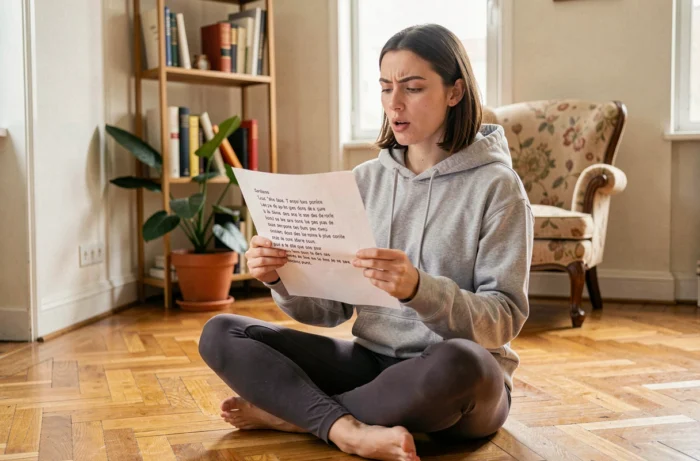
The House of My Aunt is one of those cumulative songs where each verse repeats all the previous elements while adding a new word. The text seems simple, but the real difficulty lies in the error-free chaining of the complete sequence. What are the mechanisms that make this song progressively challenging, and how can one structure home training to master it?
Sequential Memory and Cognitive Load: What Makes the Song Difficult
The House of My Aunt is based on a principle of accumulation. The first verse contains only one element (the house), the second adds one (the path), and so on until forming a chain of seven to eight elements depending on the versions: house, path, garden, apple tree, apple, bird, feather.
This format engages sequential memory, which is the ability to retain elements in a specific order. Each new verse forces the singer to recite the entire sequence in reverse order, from the last added element back to the house. The cognitive load therefore increases linearly, verse after verse.
The trap does not come from the vocabulary, which remains accessible from a young age. It comes from the tempo: as the sequence lengthens, the cumulative refrain must be recited faster to fit the melody. The last verses require a fast diction without hesitation or inversion of elements.
Finding the lyrics and text of The House of My Aunt allows one to work on each verse at their own pace before attempting the complete sequence.

Cumulative Structure Verse by Verse: Table of the Complete Sequence
Visualizing the progression helps understand why the last verses pose problems. The table below details the number of elements to remember and recite in each cumulative refrain.
| Verse | New Element | Elements in the Refrain | Total to Recite |
|---|---|---|---|
| 1 | The house | House | 1 |
| 2 | The path | Path, house | 2 |
| 3 | The garden | Garden, path, house | 3 |
| 4 | The apple tree | Apple tree, garden, path, house | 4 |
| 5 | The apple | Apple, apple tree, garden, path, house | 5 |
| 6 | The bird | Bird, apple, apple tree, garden, path, house | 6 |
| 7 | The feather | Feather, bird, apple, apple tree, garden, path, house | 7 |
In the seventh verse, the refrain contains seven elements chained in reverse order of appearance. The complete phrase becomes: “It was the feather of the bird of the apple of the apple tree of the garden of the path of the house of my aunt.” Each word must be linked to the next by a contracted article (of the, of the, of the), which adds a grammatical constraint to the memory constraint.
Variants of Lyrics and Alternative Versions
Several versions circulate, and the differences between them are not trivial for training. The most widespread variant, titled “In the Garden of My Aunt,” changes the starting point: it begins with the garden instead of the house, shortening the chain by one element.
Other versions add additional elements after the feather (a stain, a worm), bringing the total sequence to eight or nine elements. The choice of version directly determines the difficulty level of the last verse.
- Classic version (7 elements): house, path, garden, apple tree, apple, bird, feather. The most common in leisure centers and camps.
- Short version “In the Garden of My Aunt” (5-6 elements): starts at the garden, removes the house and the path. Suitable for children under five.
- Long version (8-9 elements): adds a stain on the feather, sometimes a worm on the stain. Reserved for experienced groups or adult challenges.
However, the melody remains the same regardless of the variant. Only the cumulative text changes, allowing for a transition from one version to another without relearning the tune.

Home Training Method: Progression and Associated Gestures
Repeating the song in a loop without a method yields limited results. Recent educational resources recommend a tiered approach, associating the lyrics with gestures or hand claps to anchor each element in bodily memory.
Tier 1: Mastering Each Verse in Isolation
Start by singing only the first two verses until reciting them without hesitation. Add the third only when the first two are fluid. This progression by unit addition respects the cumulative logic of the song.
Tier 2: Associate a Gesture with Each Element
Assign a distinct gesture to each word of the sequence (a roof for the house, a step for the path, a mimed tree for the apple tree). The gestures create visual and motor anchor points that facilitate recalling the order. This coordination work also makes the exercise more engaging for children.
Tier 3: Speed Up the Tempo
Once the complete sequence is memorized at a slow speed, gradually increase the tempo. The real challenge of The House of My Aunt lies here: maintaining clear diction while speeding up. Some popular video challenges offer several speed levels, from beginner to expert, to measure progress.
- Daily training of five to ten minutes, breaking it down into groups of two verses.
- Add gestures starting from the second session to avoid memorizing solely by text.
- Transition to singing in canon (two staggered groups) once the standard version is mastered, to add an additional level of difficulty.
The song The House of My Aunt functions as a progressive memory exercise disguised as a game. The sequence of seven elements, recited in reverse order with contracted articles, tests both diction and recall. Choosing the right variant according to the group’s level, breaking down learning into tiers, and associating gestures with the text remain the three most effective levers to keep the rhythm until the last verse.