For a school locker to remain functional, it is not enough to fill it at the beginning of the year and hope that order is maintained. The key to an organization that lasts throughout the year is based on a simple principle: synchronize the contents of the locker with the actual timetable, not with a logic of permanent storage.
Rotation of materials aligned with the timetable
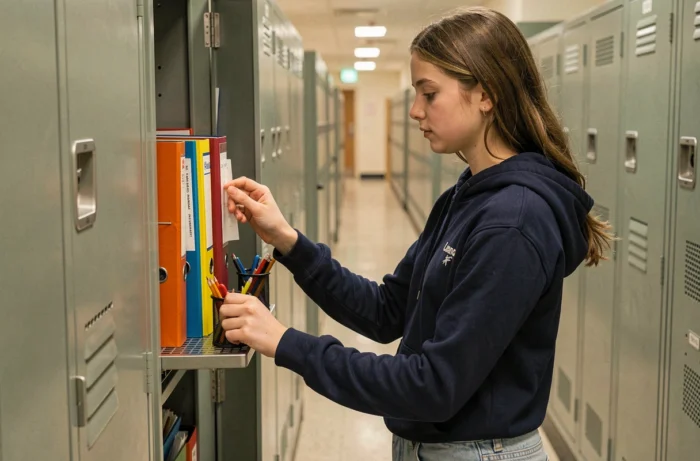
The locker is not a warehouse. We recommend treating it as a transit area where only the materials not needed for the current half-day are left. This requires a check every time you pass by, not just in the morning.
The most reliable method is to stick a reduced version of the timetable inside the locker door. Not the complete timetable, but a simplified chart indicating only the subjects that require heavy materials (binders, textbooks, sports gear). This visual cue allows for quick decisions about what stays and what goes into the bag.
Access slots to the locker are limited in most middle schools: arrival in the morning, lunch break, recess, and end of the day. A student taking the bus must anticipate by retrieving their end-of-day items during the afternoon recess, or risk being without materials for evening homework.
Sorting belongings is not enough if the sorting is not repeated regularly. What matters is the frequency with which the contents of the locker are readjusted. A daily check of the locker prevents the passive accumulation of loose papers, forgotten snacks, and outdated notebooks that ultimately render the space unusable.
To delve deeper into the basic principles, the organization for school lockers on Mes Liens Favoris details several configurations suited to different locker formats.
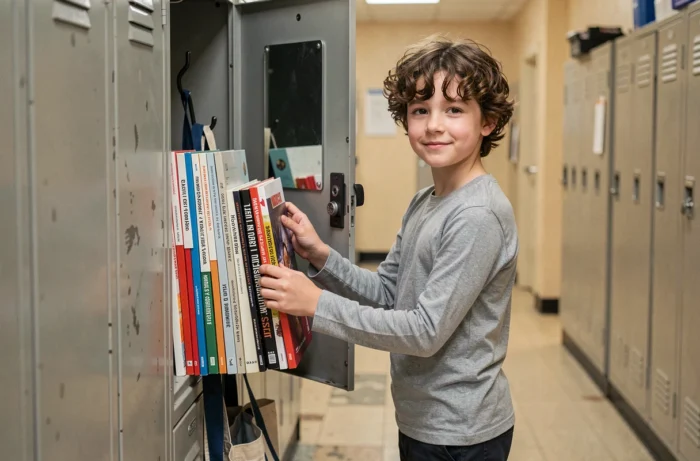
Backpack weight and locker-bag distribution
The overweight of backpacks is regularly reported as a public health issue, but no binding regulatory threshold has been set to date. The often-cited benchmark does not have the force of law. This ambiguity makes an active distribution strategy between locker and bag all the more useful.
The relevant weight is that of the backpack prepared for a typical day, including water bottle, snack, and sports gear. Weighing the bag on a Sunday evening with only the textbooks does not reflect the reality of Monday morning.
Experts remind us that the way the bag is carried is just as important as its gross weight. A well-fitted bag, worn on both shoulders and pressed against the back, puts less strain on the spine than a lighter backpack carried low on one shoulder. The locker serves here as a complementary lever: by leaving afternoon materials there, the load carried on each internal trip is reduced.
Criteria for deciding what stays in the locker
- Textbooks used less than twice a week remain in the locker between the relevant classes, rather than making daily trips in the bag.
- Sports gear only goes into the bag on the day of PE class. The rest of the time, it occupies the bottom of the locker in a separate bag to isolate odors.
- Thick binders (science, history-geography) benefit from being split: only the part currently being worked on travels, while the rest stays stored.
- Heavy occasional accessories (graphing calculator, art supplies) follow the same targeted exit logic.
Physical organization of space in a shared locker
In many institutions, a locker is assigned to two students from the same class. This constraint requires a clear division of space from day one. Defining a vertical or horizontal separation at the start of the year avoids conflicts and losses of materials that systematically occur starting in October.
The most effective configuration relies on a horizontal separation: one student occupies the upper part, the other the lower part. A simple rigid separator (thick cardboard sheet, removable magnetic shelf) is enough to mark the boundary.
Accessories that truly make a difference
A standard locker is often deep, narrow, and lacks shelves. A few well-chosen accessories can transform this raw space into functional storage:
- A small bin or rigid plastic basket at the bottom of the locker to group small items (keys, spare locks, isolated pens). Without a dedicated container, these items migrate under the binders and become impossible to find.
- A magnetic hook fixed to the inner wall to hang a lightweight fabric bag containing sports gear. The suspended bag frees up floor space in the locker.
- A transparent adhesive pocket attached to the inner door to slide in the simplified timetable and permissions to sign. This system prevents scattered loose papers.
Locker organizers sold in supermarkets (stackable shelves, magazine holders) can work, but only if the dimensions match the locker. We recommend measuring the interior before any purchase, as locker formats vary greatly from one institution to another.
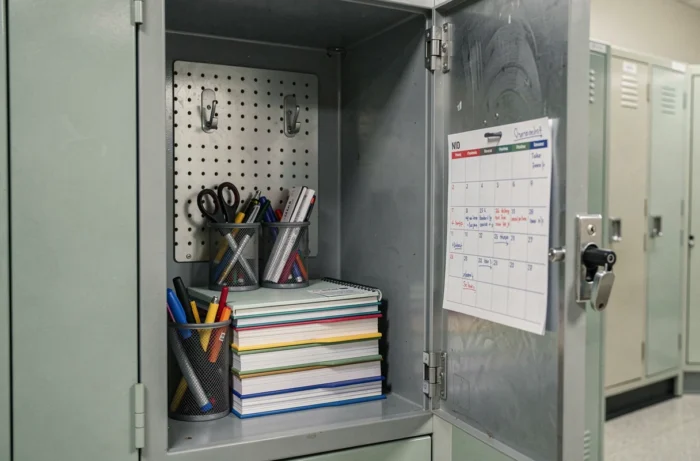
Maintaining organization after the first weeks
The real challenge is not the initial setup; it is maintaining it over time. Most locker organization systems collapse between the All Saints’ Day break and the Christmas holidays, when checks accumulate and the papers distributed in class are no longer sorted.
A complete cleaning of the locker the day before school holidays is the minimum viable action. This means completely emptying the locker, sorting what needs to go home (corrected papers, materials from completed periods), and only putting back what will be needed for the return.
Between two holiday periods, a quick weekly check on Fridays is enough to prevent congestion. The goal is to identify unfiled papers, items that do not belong there, and materials that have become unnecessary after a chapter change.
A functional locker all year round requires neither expensive accessories nor complex methods. Adapting the contents for each school period and checking the state of the locker every Friday prevents the accumulation that makes the space unusable.