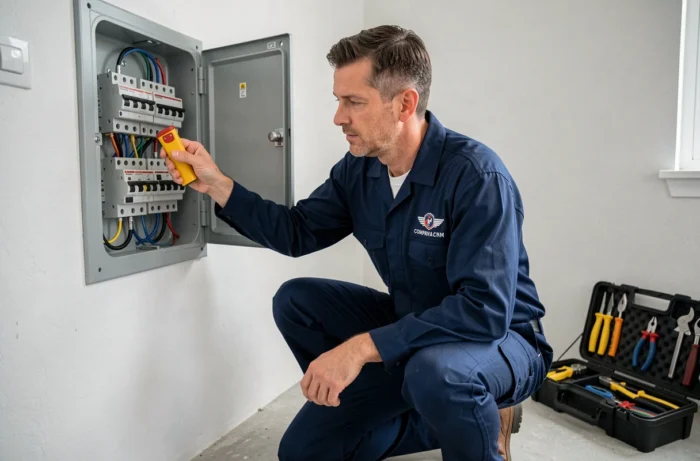
Choosing a professional electrician for electrical work directly impacts the safety of a home. The NF C 15-100 standard, professional qualifications, and actual insurance coverage: each criterion filters providers differently. This article compares these filters to identify those that truly separate a reliable craftsman from a risky operator.
Decennial insurance certificate: what the document doesn’t say
Most guides recommend requesting a decennial insurance certificate. The document itself guarantees nothing if the activity declared to the insurer does not correspond to the work planned on the site.
An electrician insured for standard residential wiring will not be covered for a photovoltaic installation, a complete electrical panel renovation, or the installation of a charging station. The activity declared to the insurer must exactly match the proposed work, and the certificate must be valid at the date the site opens.
Before signing a quote, it is therefore essential to read the certificate line by line. Professionals like those listed on electricien-cymelec.fr display their guarantees transparently, allowing verification of the alignment between the proposed service and actual coverage.
If the electrician refuses to provide this document or delays, it is an immediate warning signal. In the event of a claim on an uncovered site, the individual bears all the costs of rectification.
Electrician qualifications: comparative table of labels and authorizations
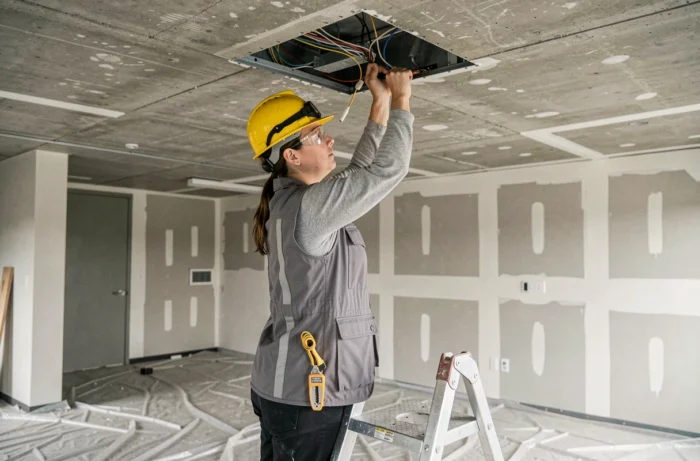
Several certifications coexist in the electrical sector. Their scope varies according to the type of work. The table below allows for comparison based on three concrete criteria.
| Qualification | Covered area | Mandatory or voluntary |
|---|---|---|
| Electrical authorization (up to date) | Any intervention on an electrical installation | Mandatory for the operator |
| Qualifelec | General electricity, low currents, renewable energies | Voluntary, issued after an audit |
| RGE (Recognized Guarantor of the Environment) | Energy-saving work (insulation, heat pump, photovoltaic) | Mandatory to access certain public aids |
| IRVE | Installation of charging stations for electric vehicles | Required as soon as the power exceeds a certain threshold |
The electrical authorization is the only legal prerequisite for intervening on a network. Other qualifications are voluntary, but their absence significantly reduces guarantees for the client.
The specific case of the IRVE qualification
With the development of electric vehicles, the demand for home charging stations is skyrocketing. An electrician skilled in domestic wiring is not automatically qualified for this service. The IRVE qualification certifies expertise in sizing and electrical protection specific to charging stations.
Requesting this qualification before any intervention on a charging station avoids compliance issues at the time of connection to the network. An installer without IRVE qualification exposes the individual to a refusal of commissioning by the network manager.
Electrician quote: the lines that reveal the level of professionalism
A professional electrician’s quote is not just a total amount. The way it is written provides insight into the provider’s rigor. Three elements deserve careful reading.
- The detailed breakdown: a serious quote distinguishes the supply of materials, labor, and travel expenses. A single flat rate, without breakdown, prevents any comparison and masks potential overestimations.
- The explicit reference to the NF C 15-100 standard: this mention in the quote contractually commits the craftsman to deliver a compliant installation. Its absence leaves a gray area in case of dispute.
- The mention of the SIREN number and decennial insurance: a quote without a SIREN number means an unverifiable company. This information must appear at the top or bottom of the document.
Comparing multiple quotes without falling into the trap of the lowest price
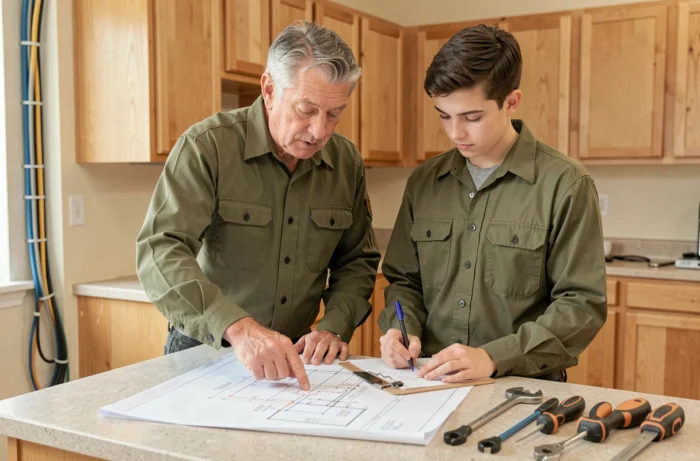
Systematically choosing the cheapest quote for electrical work is a common mistake. A significant price difference between two companies may indicate the use of lower quality materials, the absence of complete compliance, or insufficient insurance.
On the other hand, a higher quote does not automatically guarantee better work. The discriminating factor remains the precision of the document: an electrician who details each line of their intervention demonstrates mastery of their site.
Verification of the electrical company: checks accessible online
Before validating a craftsman, a few free checks can help eliminate risky situations. The Sirene directory of INSEE confirms the existence and actual activity of the company.
- Active SIREN number: a deregistered company no longer has the right to bill for work. The search takes a few seconds on the INSEE website.
- Intracommunity VAT number: its presence attests to regular tax registration with the administration.
- Cross-referenced online reviews: consulting multiple platforms rather than just one reduces the risk of encountering sponsored or falsified reviews. The most useful reviews mention a specific type of intervention (compliance, panel installation, troubleshooting).
These checks do not replace the request for direct references. A professional electrician generally agrees to provide the contact details of recent clients for projects comparable to yours.
The choice of an electrician relies less on the company’s image than on the verifiable alignment between their qualifications, insurance coverage, and the exact nature of the planned work. A detailed quote, a fully read insurance certificate, and an active SIREN number constitute the three most reliable filters before entrusting an electrical project.