
The market for organic cotton home textiles for babies and children has quickly structured itself in France. Several French brands offer ranges of sheets, sleeping bags, and textile accessories claiming local manufacturing and certified materials. Behind the marketing promises, the actual guarantees vary from one brand to another, particularly regarding the traceability of cotton and the level of certification displayed.
Certified organic cotton GOTS or mere claim: what the labels hide
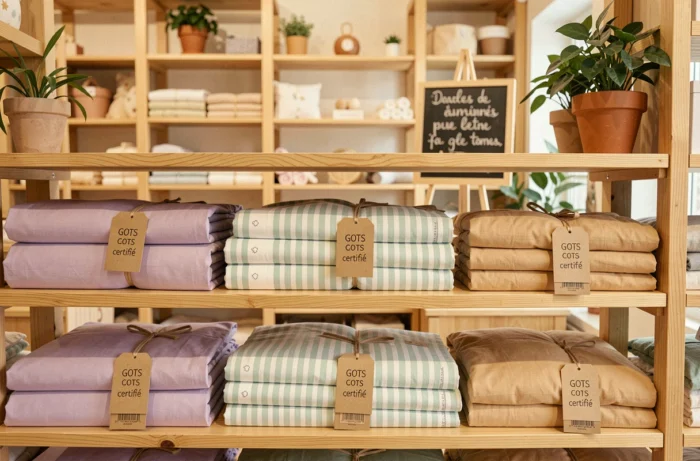
The mention “organic cotton” on a fitted sheet or a sleeping bag does not automatically guarantee verifiable certification. GOTS remains the only standard covering the entire textile chain, from raw fiber to finished product, incorporating environmental and social criteria. A product labeled GOTS must contain at least a defined proportion of certified organic fibers, and each link in the chain (spinning, weaving, dyeing, manufacturing) is subject to independent audits.
In comparison, OEKO-TEX Standard 100 does not validate the method of cotton cultivation. This label tests for the presence of harmful substances in the finished product, ensuring the safety of the textile in contact with the skin, but not its organic nature. An OEKO-TEX fitted sheet may be made from conventional cotton treated with synthetic pesticides during cultivation.
Some French brands display “organic cotton” without a GOTS certificate number or identifiable control body on their site. When selecting baby bedding, checking for the GOTS license number on the product sheet or sewn label is the only reliable way to ensure that the organic cotton is not just a commercial claim.
Among the organic cotton fitted sheets recommended by La Pommeraye, several references specify their certification number, making this verification easier.
GOTS version 8.0: what changes for French baby linen brands
The GOTS 8.0 version, published in March 2026, will become the mandatory reference for all audits starting March 1, 2027. This update is not limited to a cosmetic adjustment.
The strengthened requirements focus on three concrete areas:
- The list of chemicals allowed in dyeing and finishing is tightening, forcing suppliers to reformulate certain finishes used on children’s bedding (softeners, anti-pilling treatments).
- The criteria for wastewater management in production units are becoming stricter, with a direct impact on European manufacturing workshops that outsource dyeing outside the EU.
- The clauses related to human rights extend to the entire transformation chain, not just to cotton cultivation.
Brands that do not update their suppliers will lose their certification. For parents, this means that some ranges currently certified GOTS may no longer be after March 2027. Monitoring product sheet updates in the coming months will be relevant before making a bulk purchase of bedding.
French manufacturing of baby bedding: the limits of “made in France”
Several brands highlight French manufacturing for their sheets, duvet covers, and sleeping bags. The reality of this manufacturing deserves careful examination. “Made in France” means that sewing and assembly take place on the territory, but weaving, spinning, and cotton cultivation almost always occur elsewhere.
France does not produce organic cotton in industrial quantities. The fibers generally come from Turkey, India, or West Africa. A French baby linen brand thus works with an international supply chain, even when the final manufacturing step remains domestic.
Some brands, like Luciole et cie, manufacture in northern France with seamstresses specialized in childcare. Others, like Little Crevette, claim European manufacturing (often Portugal or Baltic countries) with certified organic cotton. The place of manufacture says nothing about the quality of the cotton or the conditions of its cultivation.
The geographical criterion matters to support local employment and reduce the carbon footprint of the final production stage. However, it does not replace reading certifications to assess the overall health and environmental quality of the product.
Concrete criteria for choosing organic cotton baby home textiles
Beyond the brand and origin, a few technical parameters allow for objective comparison of baby and children’s bedding products.
The fabric weight directly influences comfort and durability. For a baby fitted sheet, a sufficiently dense weave in percale or organic cotton satin ensures better wash resistance than lightweight poplin. Percale, a tightly woven plain weave, offers a cool and matte feel. Organic cotton satin provides a smoother touch, suitable for reactive skin, but wrinkles more easily.
The depth of the fitted sheet’s pocket is often an overlooked point. A pocket that is too short slips off the mattress as soon as the child moves, creating a risk for the littlest ones. Checking that the depth matches the exact thickness of the mattress (which varies by bedding brands) avoids unpleasant surprises.
Complementary accessories (sleeping bags, breathable crib bumpers, duvet covers) deserve the same vigilance regarding certifications. A complete set of certified GOTS bedding costs more than a conventional range, but the price difference reflects the real cost of cotton grown without synthetic pesticides and processed with controlled methods.
Ultimately, the choice of a French brand of organic cotton home textiles for babies and children relies on a trade-off between verifiable traceability, place of manufacture, and budget. Labels are not interchangeable, and the mention “organic” without certification remains a gray area that the new GOTS 8.0 requirements should help reduce.