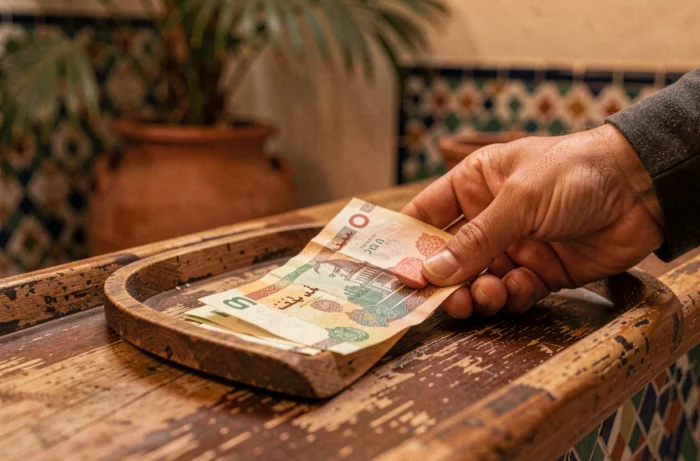
The Moroccan bakchich is not just a gesture of courtesy. It is an economic mechanism that structures the remuneration of many service professions, particularly in tourism. Knowing how to adjust the tip in Morocco requires understanding who truly depends on this supplement and to what extent, rather than applying an arbitrary percentage.
Tips and remuneration in Morocco: a structural item, not a bonus
The majority of guides, private drivers, and riad staff receive a modest base salary. The tip constitutes a significant part of their monthly income, sometimes even more than the fixed salary itself. We observe that local agencies are increasingly incorporating this reality into their quotes, recommending travelers to set aside a tip envelope upon booking.
This observation has a practical consequence: not giving a tip is not perceived as a lack of politeness, but as a failure to adhere to a local economic norm. The term bakchich, often translated as “tip,” actually covers a broader spectrum ranging from a one-time thank you to an expected gratuity for any service rendered, even if brief.
A point rarely addressed in general guides: when you book and pay for a service through a platform or an online agency, the question of how much to tip in Morocco directly to the provider becomes critical. Amounts added by card or through a platform do not always reach the driver or guide. Prioritizing cash, handed over personally, remains the only guarantee of full transmission.
Tip amounts in Morocco: a grid by type of service
There is no official Moroccan reference setting tip scales. The “normative” percentages circulating online are tacit conventions, not rules. We recommend thinking in dirhams rather than percentages, as the local logic operates on fixed tiers.
Restaurants and cafés
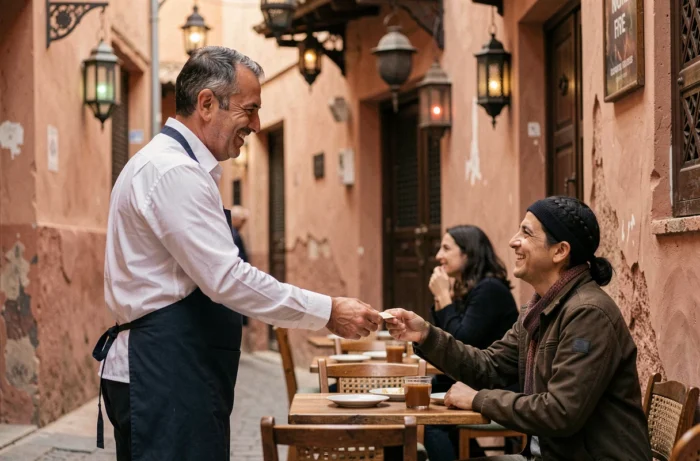
In a mid-range restaurant in Marrakech, Fès, or Casablanca, leaving a few dirhams on the table after a meal is the norm. For a coffee or a juice, a coin is sufficient. In high-end establishments, a more substantial amount is expected.
Note: some very touristy restaurants are starting to include a “service charge” line on the bill. In this case, check the bill before doubling the tip. This practice remains minority but is on the rise.
Private drivers and tours
The tip for a private driver on a multi-day tour represents a separate budget item. Specialized agencies now present it as an almost structural component of the cost of an organized stay. For a Sahara tour, add the camp staff and camel drivers to your envelope.
Tourist guides
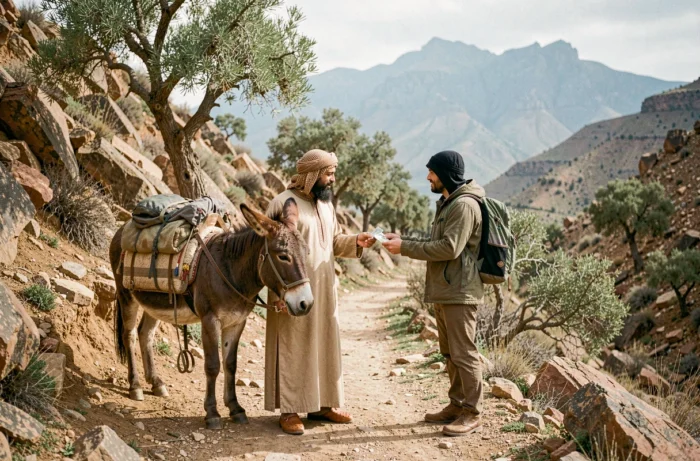
An official guide (holding a professional card) expects a tip proportional to the duration of the service. A half-day and a full day do not warrant the same amount. Unofficial Medina guides who improvise as companions also request compensation, but you are under no obligation.
Hotels and riads
- The porter receives a tip for each intervention, not a global amount at the end of the stay.
- The housekeeping staff should receive a few dirhams per day, ideally each morning rather than all at once upon departure.
- The concierge who organizes a transfer or a specific reservation deserves a separate gratuity from the standard tip.
Taxi tips and small services in Morocco
Small taxis do not operate on the same logic as tourist services. The fare is negotiated by meter (when it is activated) or at a fixed price. Rounding the amount up by a few dirhams is common, but a substantial tip is neither expected nor usual.
For parking attendants (the ubiquitous “parkeurs”), the gesture is almost systematic. The same logic applies for the gas station attendant, the porter at the souk, or the person who helps you find an address. These micro-services are part of the informal economic fabric, and a few dirhams are sufficient each time.
Common mistakes about tipping in Morocco
The first mistake is mentally converting to euros and judging the amount as trivial. A few dirhams represent a real local value. The second is grouping all tips into a single handover to the leader of a group or hotel, hoping for equitable redistribution. Giving tips individually and in cash ensures they reach the right recipient.
Another trap: reserving the entirety of your tipping budget for major services (guide, driver) and neglecting small daily services. The culture of bakchich values regularity and frequency of gestures more than their unit amount.
- Prepare small denominations in dirhams upon your arrival; large bills complicate each interaction.
- Never offer tips in euros or dollars unless explicitly requested by the provider.
- Adjust the amount to the geographical area: expectations are higher in Marrakech than in rural areas.
Tipping in Morocco does not standardize with a universal grid. Each service interaction calls for a contextual adjustment, related to the type of service, duration, and location. Keeping a permanent stock of small denominations in dirhams remains the most practical advice for navigating a stay without friction or awkwardness.