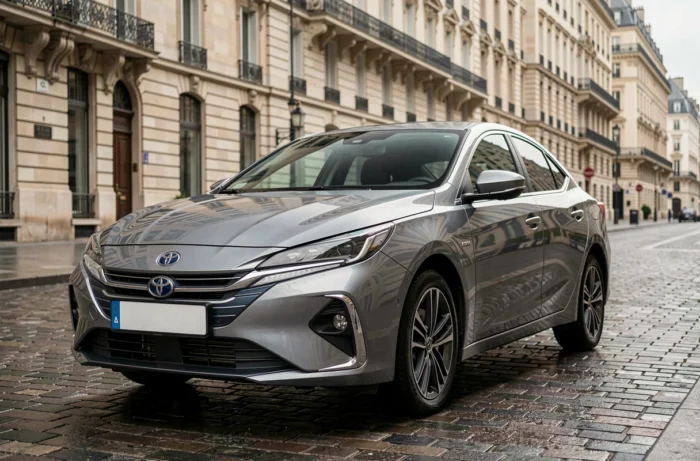
A non-rechargeable hybrid car combines a thermal engine and an electric motor powered by a battery that recharges itself, without a plug. The system recovers kinetic energy during braking and deceleration to store electricity in a small battery. This architecture allows for electric driving at low speeds, in the city or in traffic jams, and then switches to the thermal engine as speed increases.
The term full hybrid refers to this ability to drive 100% electric over short distances, as opposed to the mild hybrid 48 volts which only assists the thermal engine without ever replacing it. Confusing the two is like comparing an electric-assist bicycle to a scooter: the principle seems similar, but the results differ radically in terms of consumption.
Decline in non-rechargeable hybrid registrations in France: a signal to consider before buying
Online comparisons often present the non-rechargeable hybrid as a sustainable compromise. Data from the French market published in the summer of 2026 tells a different story. Registrations of non-rechargeable hybrid vehicles are declining, both in volume and market share, while 100% electric cars are progressing strongly.
In August 2026, new electric vehicles accounted for more than a third of registrations in France. This trend does not condemn the full hybrid, but it changes the calculations for a buyer. A non-rechargeable hybrid model purchased today may be resold in a used market where demand could continue to shift towards electric vehicles.
For those considering this type of engine, consulting a comparison of non-rechargeable hybrid cars 2026 remains useful to identify models whose residual value holds up best in this context.
Crit’Air and ZFE access: the criterion that comparisons underestimate
Most buying guides mention the Crit’Air sticker in passing, without explaining its concrete consequences. In 2026, it has become a selection criterion on par with consumption.
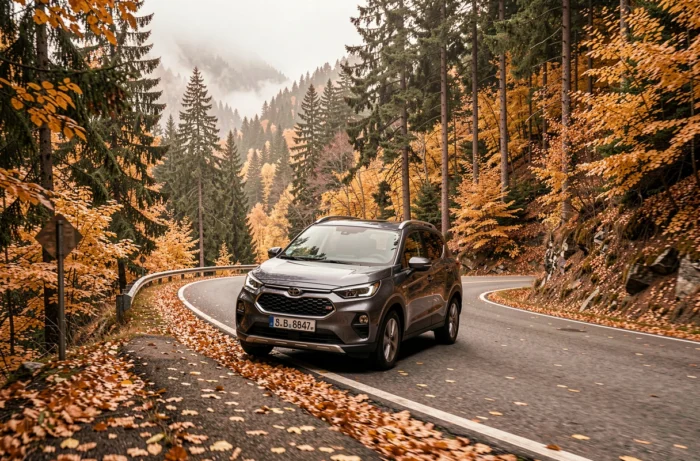
A non-rechargeable gasoline hybrid generally receives a Crit’Air 1 sticker. A non-rechargeable diesel hybrid remains classified as Crit’Air 2. The difference seems minimal on paper. In practice, low emission zones (ZFE) in several major French metropolitan areas are gradually restricting access to Crit’Air 2, with exclusion schedules varying from one city to another.
A buyer who regularly drives in downtown Lyon, Paris, or Marseille must check the local ZFE schedule before signing. Choosing a diesel hybrid in 2026 may limit access to certain ZFE in the two or three years following the purchase.
Real consumption in non-rechargeable hybrids: what affects the bill
The consumption figures displayed by manufacturers follow the WLTP cycle, a standardized protocol. Real conditions can deviate from this, sometimes significantly, depending on the usage profile.
The full hybrid performs best in urban and suburban traffic, where braking and low-speed driving phases allow for battery recharging and frequent electric mode driving. On the highway, at stabilized speeds above 110 km/h, the thermal engine operates almost alone. Consumption then approaches that of a conventional thermal vehicle of similar size.
- In the city and on short trips (less than 30 km), the full hybrid fully exploits its electric phases and significantly reduces consumption compared to a thermal engine alone.
- On mixed roads (suburban, departmental), the gain remains notable due to the acceleration-braking alternations that feed the battery.
- On long-distance highways, the advantage of the hybrid system decreases significantly, as opportunities to recover energy are rare.
A buyer whose trips are mostly highway-based will gain little benefit from a full hybrid. The driving profile determines real savings more than the vehicle’s technical specifications.

Full hybrid models to watch in 2026: three segments, three logics
Rather than a linear ranking of ten models, it is more useful to reason by segment, as expectations differ radically between a city dweller, a family, and an SUV driver.
City cars and small hybrid crossovers
The Toyota Yaris Cross hybrid remains a reference in this segment. Its fourth-generation hybrid mechanics have proven reliable. The Renault Captur e-Tech full hybrid is positioned at a lower entry price, making it one of the most affordable entry points in the French full hybrid market.
Hybrids in sedans and family cars
The Honda Jazz e:HEV offers a rare modular interior in its category, with one of the lowest mixed-cycle consumption figures in the segment. The Kia Niro Hybrid stands out with a longer-than-average manufacturer warranty, a concrete argument for resale.
Non-rechargeable hybrid SUVs
The Honda ZR-V e:HEV hybrid and the Renault Austral e-Tech full hybrid compete in the compact SUV segment. The Nissan Qashqai e-Power uses a unique architecture: the thermal engine never drives the wheels, it only serves as a generator for the electric motor. This design provides a driving pleasure close to that of an electric vehicle, with an unusual smoothness for a hybrid.
The Jaecoo, a Chinese brand recently entered into the European market, aims to compete with Toyota in the non-rechargeable hybrid segment with a 1.5 TGDI engine. Long-term reliability and after-sales service network remain to be confirmed.
The full hybrid market in 2026 remains relevant for frequent urban and suburban trips, provided that Crit’Air compatibility with local ZFE is checked and that a shift in demand towards electric is anticipated. The most solid choice remains a gasoline model with a Crit’Air 1 sticker, from a manufacturer with a well-established maintenance network in France.