Local regulations now heavily condition the practice of green outdoor activities. Before planning a nature outing, hike, or bivouac, we recommend systematically checking the current prefectural and municipal orders in the targeted area. Restrictions related to fire risk, nesting, or dog presence turn a simple walk into an exercise in administrative compliance.
Bivouac regulations and trail access restrictions
Bivouacking in France is not based on any uniform rule applicable across the entire territory. Conditions vary according to the status of the site, municipal orders, and regulations specific to each national park.
In the Écrins or Vanoise, one night is tolerated under certain time conditions and at a specific distance from roads and shelters. The Calanques, on the other hand, completely prohibit bivouacking in a large part of their perimeter. The Cévennes apply an intermediate regime with dedicated areas.
Each overnight outing requires site-by-site verification. Prefectures can also limit or temporarily prohibit access to certain trails during periods of fire danger, including across multiple municipalities simultaneously. This constraint particularly affects southern France between June and September, but it is gradually extending to other departments during drought episodes.
We observe that most outdoor recreation guides omit this preliminary verification step. The reflex to adopt: consult the website of the prefecture of the relevant department and the municipal signs (sometimes accessible via apps like PanneauPocket) before any committed outing. Several resources reference nature activities available by territory, such as loisirs-verts.fr, which allows targeting outings adapted to the local regulatory framework.
Hiking and walking in nature: growth of the practice and terrain preparation
Walking and hiking continue to grow in France. This rise is accompanied by a densification of the most well-known trails and accelerated wear of certain routes.
Favoring secondary routes reduces pressure on sensitive environments while offering a more immersive experience. The GR de pays and PR marked by departmental committees remain under-frequented compared to the major media-covered crossings.
Preparing a hiking outing according to the terrain profile
The choice of route depends less on the distance than on the cumulative elevation gain and the nature of the ground. A trail on limestone cliffs with exposed sections requires a high-top shoe with a rigid sole, whereas a flat forest path can be traversed in light trail shoes.
- Check local weather conditions and prefectural alerts (heatwave, storms, wind) in the 48 hours preceding the outing
- Adjust the amount of water carried according to the profile: in exposed environments without shade, consumption increases significantly compared to a route under forest cover
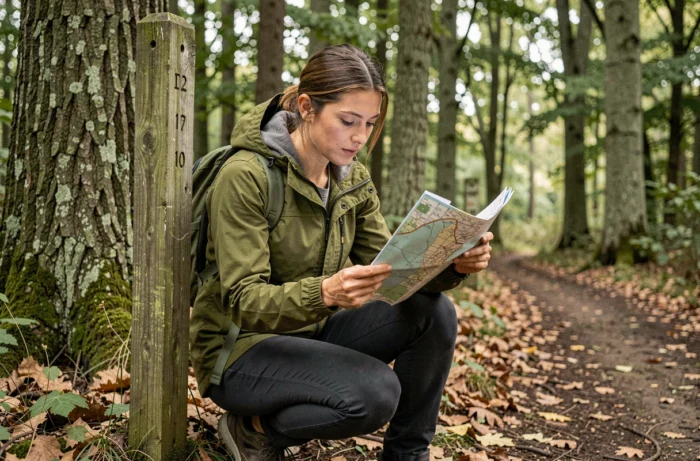
- Bring an IGN map at a scale of 1:25,000 of the area, even with a GPS, as network coverage remains unreliable in cliff or narrow valley areas
- Inform someone of your route and estimated return time, especially for solo outings on less-frequented trails
Outdoor activities with a dog: legal framework and coexistence
Dog ownership is subject to increased regulation in many natural spaces. Local orders require leashes on trails, prohibit access to certain beaches during the summer season, and restrict the presence of dogs in sensitive natural areas during nesting periods.
In nature reserves or the core of national parks, a dog’s wandering, even when called back, can result in a fine. The critical period is between March and July, when ground-nesting birds (larks, pipits, plovers) are particularly vulnerable.
We recommend consulting the municipal orders of the outing location and systematically planning a five-meter leash for passages in regulated areas. The goal is not to give up on nature outings with your pet, but to anticipate sections where the leash becomes mandatory to avoid fines.
Gardens and green spaces: an underestimated alternative for family nature adventure
Botanical gardens, arboretums, and landscaped parks provide an ideal setting for nature activities accessible to all levels of physical fitness. These spaces combine biodiversity observation with ease of access, without the logistical constraints of an engaged hike.
Several territories have remarkable labeled gardens, often unknown to the general public. The educational interest goes beyond a simple walk: identification of species, understanding local ecosystems, discovery of seasonal cycles.
Team nature activities in a supervised environment
For outings in teams or large families, regional natural parks often offer activities supervised by naturalist guides. These formats allow structuring a day outdoors around a concrete objective: landscape reading, animal track recognition, introduction to field botany.
- Group nature discovery activities work best in two to three-hour slots; beyond that, concentration drops significantly among children
- Basic observation equipment (binoculars, field magnifiers, naturalist notebooks) greatly enhances participant engagement
- Plan a weather backup: a route in the underbrush is a good substitute for a prairie outing in case of rain
Access to green outdoor recreation is not limited to choosing between hiking and picnicking. The regulatory dimension has become a full-fledged planning parameter, on par with weather or the physical level of the group. Checking local orders, adapting equipment to the actual terrain, and respecting ecological sensitivity periods transform an ordinary outing into a sustainable experience, for both the practitioner and the natural environment.