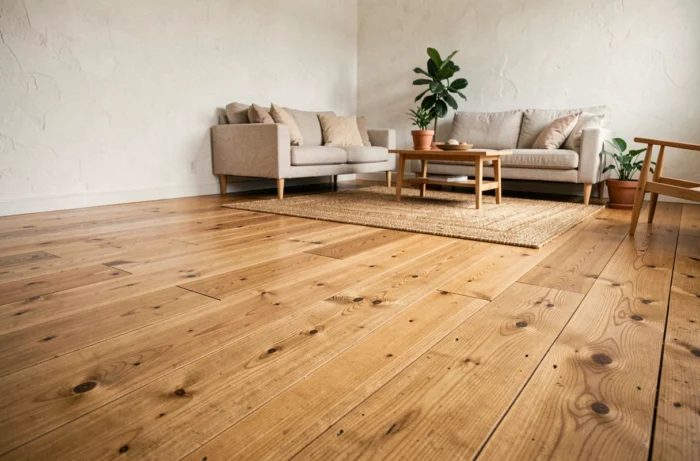
A floor covering rated A+ according to the French regulatory label is not necessarily a healthy floor. The emission class only measures about ten targeted VOCs, not the entirety of the substances released. For a truly more natural interior, the choice depends on the material’s composition, its installation method, and the nature of surface treatments.
VOC emissions and formaldehyde thresholds: what the A+ label does not cover
Since September 2013, all floor coverings sold in France must bear a label rated from A+ (very low emissions) to C (high emissions). This system serves as a minimum filter, not a complete health guarantee.
The label evaluates about ten identified volatile organic compounds. Heavy aldehydes, phthalates, or flame retardants present in some soft PVC floors are not all included in the measurement protocol. Therefore, an A+ rated PVC floor may emit substances not measured by the standard.
Requirements are tightening regarding formaldehyde. European thresholds fully applicable in 2026 impose a limit of 0.062 mg/m³ of formaldehyde for composite woods, which directly affects laminated and engineered wood floors. A laminate that does not comply with this threshold measurably degrades indoor air quality. We recommend checking, beyond the emission class, whether the manufacturer displays compliance with the applicable formaldehyde standards in 2026.
To find out which healthy floor covering to prioritize in this regulatory context, one must cross-reference the VOC label with the actual composition of the product and its installation system.
Actual composition of so-called natural floors: linoleum, cork, and solid wood
The term “natural floor” encompasses very different realities in terms of formulation and industrial process.
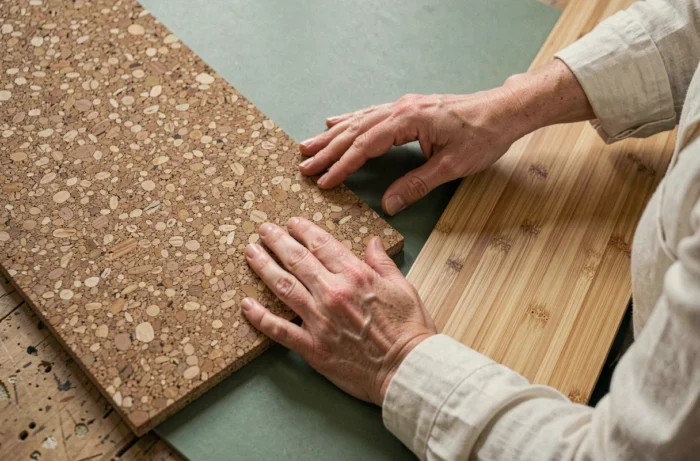
True linoleum (not to be confused with soft PVC flooring often referred to as “lino” by misuse of language) is made from linseed oil, pine resin, wood flour, and jute. Its composition places it among the healthiest coverings on the market. It emits almost no VOCs after installation, provided it is glued with a low-emission adhesive.
Cork, when offered in solid tiles, has a similar profile. However, composite cork floors include an HDF layer (high-density fiberboard) whose binder contains formaldehyde. The distinction between solid cork and composite cork is rarely clarified in stores.
Certified solid wood flooring (FSC or PEFC) remains a benchmark. Its critical point is not the wood itself, but the finish:
- A conventional polyurethane varnish emits VOCs for several weeks after application, sometimes exceeding the A+ class
- A vegetable oil (linseed, tung) penetrates the fiber without creating a synthetic film and reduces post-installation emissions to nearly zero
- A natural wax offers a compromise but requires regular maintenance to maintain wood protection
The finish determines as much the air quality as the material of the floor. A solid wood floor finished with polyurethane may emit more than a linoleum glued with a water-based adhesive.
Installation method and adhesives: the underestimated factor in health assessment
We regularly observe that the choice of covering is careful, but the installation method is neglected. Adhesive is, however, a major source of emissions in the first weeks following implementation.
Floating installation without glue eliminates this problem at the root. It is suitable for engineered wood, click cork, and certain laminates. In return, it can generate acoustic resonance if the underlayment is poorly chosen.
When gluing is necessary (linoleum, cork tiles, certain solid wood floors), we recommend adhesives rated EC1 Plus (very low emissions), or even silane-modified glues, without solvent or isocyanate. The Emicode EC1 Plus standard is more demanding than the French A+ label regarding the range of substances tested.
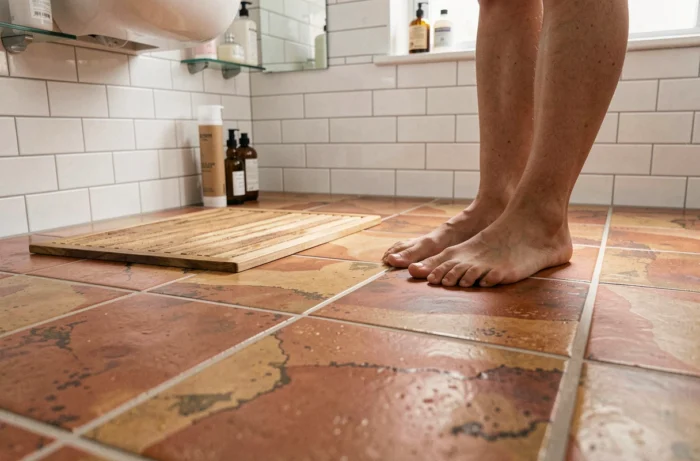
For wet rooms, ceramic tiles laid with mortar remain the most chemically inert choice. No VOC emissions, very long durability, simple maintenance. Its ecological balance mainly depends on transport distance and firing energy, not on its composition during use.
Selection criteria by room: adapting the floor to the actual constraints
A healthy floor poorly positioned in the house loses some of its qualities. Cork, effective in thermal and acoustic insulation, does not tolerate permanent humidity well without appropriate surface treatment. Placing it in an unventilated bathroom compromises its durability.
- Living areas (living room, bedrooms): oiled solid wood or true linoleum, floating or glued EC1 Plus
- Kitchen: linoleum (stain-resistant) or porcelain stoneware tiles, depending on the level of use
- Bathroom: tiles laid with mortar, natural stone waterproofed with a solvent-free water repellent
- Children’s room: click solid cork (shock absorption, thermal comfort, zero glue)
Each room imposes a trade-off between comfort, moisture resistance, and emission levels. A single material for the entire house is rarely the best health strategy.
Labels to check before purchase
Beyond the mandatory VOC label, Natureplus labels, the European Ecolabel, and FSC/PEFC certifications on wood provide additional guarantees on the product’s life cycle. The Emicode label on the adhesive complements the system. Cross-referencing the floor label and the adhesive label gives a reliable picture of the overall health assessment of the installation.
The choice of a healthy floor covering is not limited to selecting a material labeled “natural.” The finish, the adhesive, and the suitability for the room weigh as much as the raw material. Checking compliance with the 2026 formaldehyde thresholds and requiring an EC1 Plus adhesive are two concrete reflexes that truly change indoor air quality.