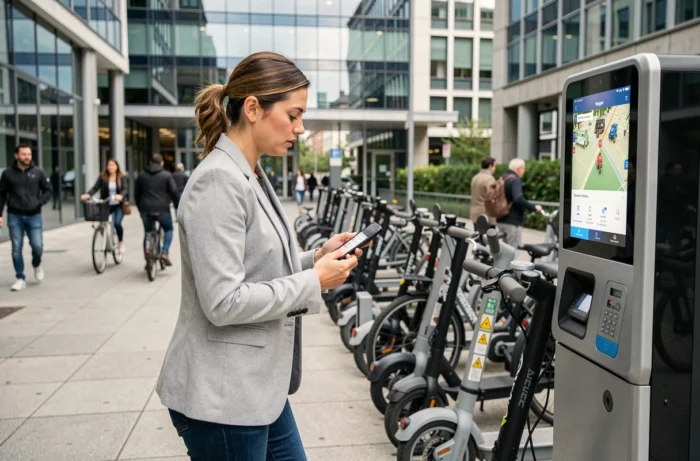
In September 2026, low-emission mobility zones (ZFE-m) remain active in several French metropolitan areas, despite political announcements suggesting their removal. The government is also considering making helmet use mandatory for electric scooter users, although a uniform national law has yet to be established.
In this shifting landscape, optimizing urban travel requires navigating rules that vary from one municipality to another and assistance programs whose mandatory or optional nature can be confusing.
ZFE in 2026: restrictions still active despite political ambiguity
Many motorists believe that ZFEs have been abandoned. However, field reports show the opposite: circulation restrictions based on the Crit’Air sticker continue to apply in the urban areas that established them. The confusion partly stems from government announcements about a possible easing, which have been reported without verification by some media outlets.
For a user looking to optimize their daily commutes, the first step remains to check the applicable ZFE rules in their metropolitan area. Each local authority retains control over the schedule and scope of its zone. One city may tighten its criteria while another freezes its own.
This situation creates a regulatory patchwork that is difficult to follow. A vehicle classified as Crit’Air 3 may circulate freely in one urban area while being prohibited from entering a neighboring one. Before planning an intercity trip or changing modes of transport, it is essential to consult the up-to-date municipal orders, often accessible on the websites of the relevant metropolitan areas. Several platforms aggregate this data to facilitate planning, notably at https://gomode.fr, which lists alternative mobility solutions tailored to each territory.
Sustainable mobility package: what the employer must (and must not) finance
The sustainable mobility package allows a private sector employer to cover the costs of commuting trips made by bike, carpooling, scooter, or car-sharing. However, this scheme remains optional for private employers. It should not be confused with the legal obligation to reimburse part of public transport subscriptions.
The distinction has concrete consequences. An employee who abandons their car in favor of a bike has no guarantee of receiving assistance from their company unless a company agreement or a unilateral decision by the employer has provided for it. Available data does not allow for conclusions about the actual adoption rate of the package in SMEs, but field reports show a clear divergence between large companies (where the scheme is often negotiated) and smaller structures.
For an employee, the useful approach is to ask their HR department about the existence of the package, then compare the proposed amount with the actual cost of the intended mobility solution. A daily trip by electric bike incurs maintenance and insurance costs that the package does not always fully cover.
Electric scooters in the city: a regulation that is becoming territorial
The government announced in September 2026 its intention to impose helmets on electric scooter users. This measure is not yet generalized by national law. In practice, the rules already vary from one department or municipality to another, complicating life for regular users.
Some cities have limited the speed of self-service scooters, while others have restricted parking areas or prohibited circulation on certain sidewalks. A user traveling between two neighboring municipalities may find themselves in violation without knowing it.
- Check municipal orders regarding parking and the allowed speed of scooters in each municipality crossed.
- Anticipate the helmet requirement, which is already recommended and potentially imposed in the short term.
- Prefer marked bike lanes when they exist, as sidewalk circulation remains prohibited in most urban areas.
This regulatory fragmentation raises a fundamental question: without a unified national framework, the scooter remains a variable urban mobility solution. Its integration into a multimodal trip (scooter + metro + bus) depends as much on local infrastructure as on regulatory tolerance.
Intermodality and trip planning: moving beyond the car reflex
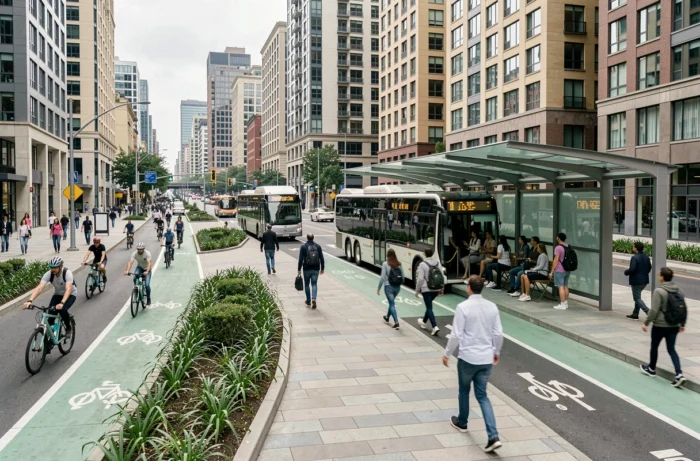
Combining multiple modes of transport on the same trip remains the most effective lever for reducing time spent in traffic. Metropolitan areas that have invested in park-and-ride facilities at city entrances, secure bike shelters at train stations, and integrated ticketing facilitate this shift.
The main barrier is not technological. The lack of reliable real-time information on connections discourages users. An unreported bus delay is enough to miss a train connection, and the car reflex takes over again the next day.
Multimodal planning applications are progressing, but their coverage remains uneven across territories. In medium-sized urban areas, public transport data is not always open or updated. Users then have to juggle between several applications, which partially negates the expected time savings.
- Park-and-ride facilities work better when they are located in immediate proximity to a frequently serviced public transport station.
- Integrated ticketing (a single ticket for bus, tram, and self-service bike) reduces friction when changing modes.
- Local authorities that publish their transport data as open data allow third-party applications to offer more reliable routes.
Short-distance carpooling: an underutilized potential in dense areas
Carpooling is often associated with long-distance trips. However, in urban and peri-urban areas, it represents an underutilized decongestion lever. Several local authorities have established carpool lanes or subsidies for the first trip, but the average occupancy rate of vehicles in the city remains low.
The issue lies less with the availability of platforms than with the regularity of trips. A home-to-work carpool only works if the schedules of both parties consistently coincide. Field reports show that the most effective schemes are those initiated by employers themselves, who organize connections between employees in the same job market.
Car-sharing complements this picture for occasional trips: a vehicle shared among several households reduces the number of cars parked in the city and frees up public space. Both schemes benefit from being considered together, within the framework of an employer mobility plan or a municipal travel scheme.
Optimizing urban travel in 2026 means first accepting that rules change quickly and locally. The best transport combination depends as much on the territory as on individual habits, and no single solution replaces regular verification of the accessible schemes at one’s address.