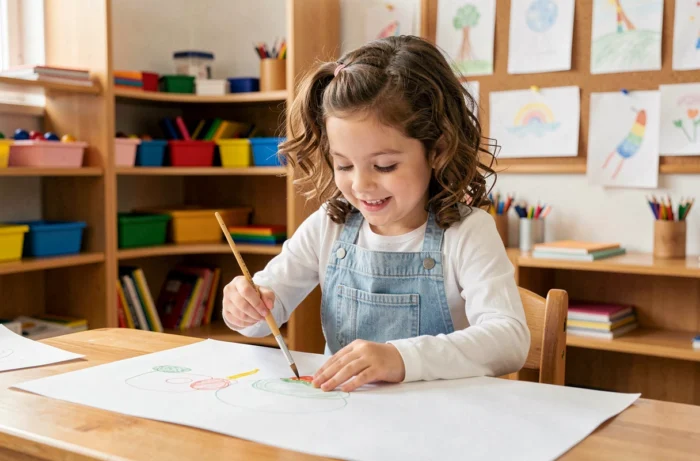
A child stacking blocks, another inventing a story with two figurines: these seemingly trivial moments engage coordination, language, and problem-solving skills. Playful and educational activities are not just a bonus added to the day. They are the main lever for learning before the age of six, provided the context is conducive.
Adult Support and Educational Activities: The Often Underestimated Factor
Simply offering a game labeled “educational” is not enough to produce a measurable effect on a child’s development. Recent summaries converge on one point: an educational game has a greater impact when an adult is involved. The adult rephrases, asks open-ended questions, and refocuses attention.
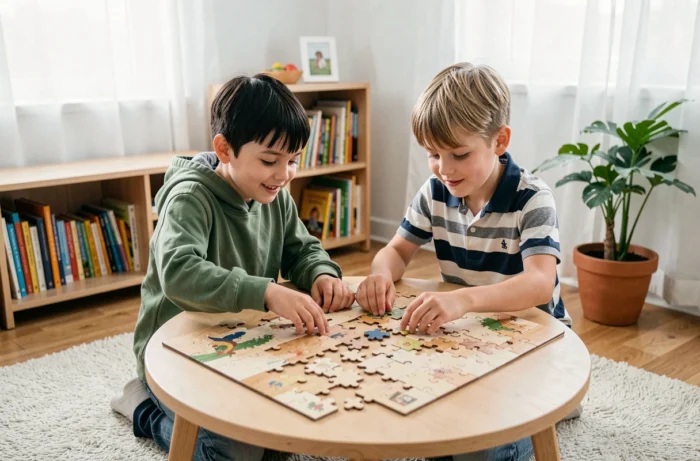
Take a puzzle, for example. Left alone, a three-year-old may give up after a few seconds of frustration. With a parent naming colors, pointing out a shape, or encouraging another attempt, the same puzzle works on fine motor skills, vocabulary, and perseverance.
This support does not require any special skills. It relies on three simple conditions:
- Adapt the difficulty to the child’s actual level, not their theoretical age. A child who masters a game effortlessly learns nothing.
- Set a clear, even modest, goal: recognize three colors, reproduce a rhythm, sort objects by size.
- Remain available without directing. Guide with questions (“Where do you think this piece goes?”) rather than instructions (“Put it here”).
Online catalogs allow you to find materials suitable for each age group. For families looking for toys and activities sorted by developmental stage, discover Poupala for children for a selection designed with this logic in mind.
Free Play and Creativity: Why the Absence of Rules Helps the Child Progress
Have you ever noticed that a child can spend a long time playing with an empty cardboard box, while a sophisticated toy occupies them for just a few minutes? This is not a coincidence. Free play, without imposed instructions or goals, intensely engages imagination and decision-making.
When a child transforms a box into a boat, they must visualize the absent object, verbalize their scenario, and negotiate roles if another child is involved. This process simultaneously develops language, creativity, and social skills.
Role play operates on the same principle. Playing shopkeeper, doctor, or veterinarian requires reproducing sequences observed in daily life and then modifying them. The child does not recite: they reinvent. This transition from imitation to invention corresponds to a cognitive leap that highly structured activities do not stimulate in the same way.
What Materials for Free Play
Everyday objects (boxes, fabrics, wooden spoons, clothespins) often work better than single-function toys. An open-ended object invites the child to decide how to use it, which activates their thinking more than a toy with a single button.
Wooden toys, gender-neutral figurines, or building blocks remain reliable choices. The idea is not to ban plastic, but to prioritize objects that allow for multiple play scenarios.
Screens and Screen-Free Activities: Balancing Children’s Time
The French report “Children and Screens: In Search of Lost Time,” submitted in April 2024, has refocused the debate. It is no longer just about limiting screen time. Recommendations emphasize the protection of interactions, free play, sleep, and physical activity, with particular vigilance before the age of three.
In collective care settings, French regulations now directly govern screen exposure. For early childhood professionals, offering screen-free activities is no longer just advice: it is a requirement.
What Screens Are Concretely Replacing
The problem is not the screen itself, but what it replaces. Half an hour in front of a video means half an hour less for manipulating objects, running, talking, or drawing. For children under three, these physical and sensory activities build the foundations of motor skills and language.
For older children, content matters as much as duration. A drawing app used with a parent does not have the same effect as passive video streaming. Recent French recommendations emphasize the presence of an adult, the quality of the content, and maintaining daily routines (meals, sleep, outdoor time).
Motor Skills and Physical Activities Suitable for Each Age
Motor skills are not limited to sports. Before the age of two, climbing on a cushion, filling a bucket with sand, or tearing paper constitutes complete motor training. These simple actions strengthen hand-eye coordination and prepare for writing.
Between the ages of three and six, physical activities become more complex. Jumping on one foot, throwing a ball at a target, following an obstacle course: each exercise works on balance, lateralization, and spatial awareness. Daily physical activity also enhances concentration in class, a link that education professionals regularly observe.
Hands-on activities complement this work. Cutting, gluing, and molding salt dough engage fine motor skills while providing a visible result, which reinforces the sense of autonomy. The child is not just “doing crafts”: they are learning to plan a sequence (choose, cut, assemble) and manage frustration when the result does not match the initial idea.
Adjusting Difficulty Rather Than Activity
The same game can serve different ages if the level is adjusted. A construction game can be used for free stacking at two years old, for model reproduction at four years, and for inventing symmetrical structures at six years. Adjusting the difficulty extends the lifespan of the game and keeps learning active.
Children’s development does not follow a universal timeline. Two children of the same age can have very different motor skills. Observing before proposing remains the best method for choosing the appropriate activity, rather than relying on the age range indicated on the packaging.