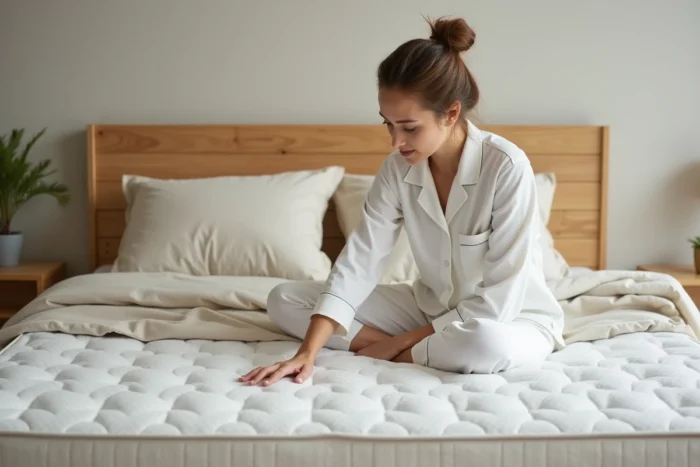
Bultex refers to a polyurethane foam with open cells, developed and patented by the French brand of the same name. Latex, on the other hand, is an elastic material derived from the sap of rubber trees (natural latex) or produced through chemical synthesis (synthetic latex). Both technologies share the same goal of providing suitable support for the sleeper, but their composition, cellular structure, and behavior differ in ways that are significant when making a choice.
Cellular structure and mechanical behavior: what really separates Bultex and latex
Bultex foam is based on micro-cells of varying sizes that function like small independent springs. These cells, larger than those of latex, work deeply and offer a wide range of firmness, from medium-firm to extra-firm.
Latex has a different structure. Its cells are very fine, comparable to pinheads. They primarily act on the surface, producing a soft feel combined with firm support underneath. The resilience of latex is remarkable: the material returns to its original shape almost instantly after compression.
This structural difference explains why a Bultex mattress offers more comfort variations than a latex mattress, which remains limited to a soft feel/firm support profile. To delve deeper into the difference between Bultex and latex mattresses, the density and composition of the core remain the two parameters to examine first.

Mattress density: a criterion often misunderstood
Density, expressed in kg/m³, measures the amount of material per unit volume. It directly affects the lifespan of the mattress and the quality of support. Comparing densities between Bultex and latex without caution leads to errors, as the two materials do not use the same scale.
Latex density versus Bultex density
A latex mattress typically has a high density, often ranging from 50 to 95 kg/m³ according to manufacturer sources. This significant density indicates a heavy, compact material that resists sagging over time.
Bultex foam, being lighter by nature, achieves lower densities for a comparable level of support. A well-made Bultex mattress provides satisfactory support at a lower density thanks to the specific geometry of its cells. Comparing a raw density figure between the two technologies makes no sense without considering the internal structure of the material.
What density changes in daily life
A density that is too low, regardless of the material, accelerates the formation of permanent indentations. On a latex mattress, the high density also contributes to the overall weight of the product, making handling (flipping, transporting) more difficult. A Bultex mattress will be significantly easier to move.
Labels and actual composition: natural latex does not mean organic latex
The label “natural latex” does not guarantee a product free from synthetic components. A mattress can carry this designation while containing only a fraction of rubber tree sap, the rest being synthesized latex from petrochemicals.
For a latex mattress to be considered truly natural, the percentage of rubber tree sap must exceed half of the composition. According to Alternative-Habitat, some mattresses labeled “natural latex” actually contain only 30 to 40% rubber tree sap.
- The Oeko-Tex label certifies the absence of harmful substances but does not assess the proportion of natural materials or the overall ecological impact of the product.
- The GOLS (Global Organic Latex Standard) and Eco-Institut certifications specifically verify the organic nature and actual composition of the latex.
- The FSC or Rainforest Alliance certification focuses on the sustainable management of rubber tree plantations, not on the finished mattress.
An Oeko-Tex certified mattress can be mostly synthetic. For an informed ecological choice, cross-referencing multiple labels remains the only reliable method. Bultex foam, derived from petroleum, does not claim these organic certifications, which paradoxically simplifies the reading of its label.

Ventilation, allergies, and durability: three criteria to decide
Thermal regulation and breathability
Natural latex regulates temperature better than most synthetic foams due to its open-cell structure and perforations. Bultex foam, designed with micro-cells, also offers good air circulation, but sleepers sensitive to heat will prefer natural latex.
Hypoallergenic properties
Natural latex has recognized antibacterial and anti-mite properties, linked to the composition of rubber tree sap. Bultex foam can receive hypoallergenic treatments, but these are added during manufacturing and are not intrinsic to the material.
Note: a latex allergy exists and affects a fraction of the population. In this specific case, the choice defaults to Bultex foam or synthetic latex, which does not contain the proteins responsible for the reaction.
Lifespan and resistance to sagging
Natural latex resists sagging over time better than synthetic foams. Its high density and intrinsic elasticity allow it to maintain its supportive properties longer. A quality Bultex mattress offers a decent lifespan, but polyurethane foam ages faster than a dense latex block.
- High-density natural latex retains its supportive qualities for a longer period than Bultex foam.
- Bultex compresses more quickly if the density of the chosen model is insufficient for the sleeper’s weight.
- A slatted base remains the recommended support for both technologies, as it promotes ventilation and extends the lifespan of the mattress.
Which mattress to choose based on your sleeping profile
The choice between Bultex and latex depends on three variables: thermal sensitivity, budget, and ecological requirements. Bultex is suitable for sleepers seeking a wide range of firmness levels without weight constraints of the mattress. Natural latex is aimed at those who want a resilient, cool, and durable material, accepting a heavier product and often a higher price.
The combination of the mattress with a suitable slatted base remains a comfort factor at least as decisive as the choice of the material itself. A good mattress placed on an unsuitable base loses a significant part of its supportive and ventilating qualities.